Transforming CommBank iQ service delivery through blueprinting

Using service design to visualise workflows and enhance the end-to-end customer experience
Expanding design impact beyond products
While working on product challenges in our banking and data organisation, I recognised an opportunity to improve customer experience by examining how our entire service delivery system worked. As the sole designer, I mapped how customers experienced our services across multiple touchpoints and teams.
Creating visibility through service blueprinting
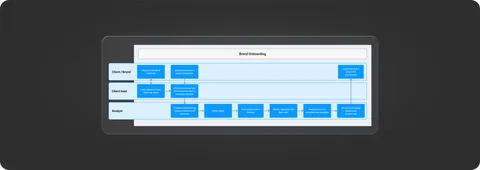
To understand how our service delivery worked, I ran a service blueprinting project that mapped workflows across teams and departments. I interviewed team members from different areas and facilitated collaborative sessions to document both customer-facing interactions and behind-the-scenes operations.
The service blueprint created visibility into the entire customer journey, revealing how staff activities supported each interaction, where system dependencies created friction, and how communication flowed between departments. Most importantly, it highlighted pain points affecting both customers and staff that hadn't been visible when looking at individual processes in isolation. The cross-departmental view broke down silos that had previously limited visibility, and showed everyone how each team contributed to the overall customer experience.

Uncovering systemic opportunities for improvement
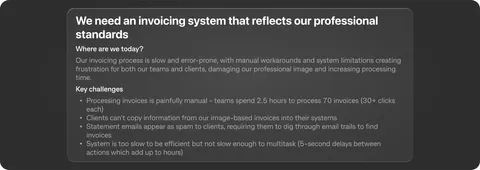
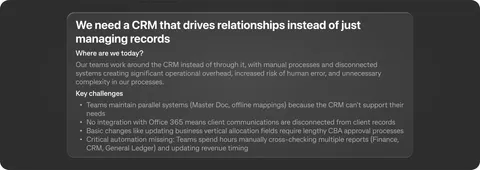
The blueprinting work revealed insights that wouldn't have been visible through product-focused approaches alone:
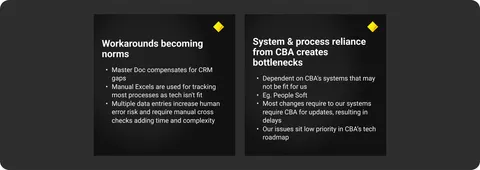
- Siloed reporting systems: Teams worked from disconnected information sources, making it difficult to gain a complete picture of customer interactions
- Duplication of effort: Many people across teams were performing similar tasks in isolation
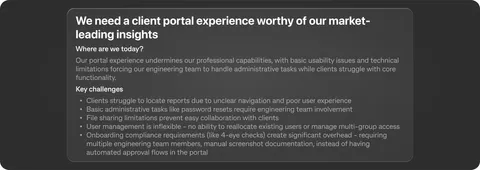
- Parent company tool limitations: Our parent company's tools weren't optimally configured for our needs, so workflows were less efficient
- Customer experience gaps: Handoffs between teams created potential gaps in the customer experience that affected consistency and transparency
The blueprint showed these as interconnected parts of one larger system rather than isolated issues.
From mapping to action
Following the blueprinting work, I helped leadership identify where to focus our improvement efforts. My recommendations centred on four areas:
- Integrated reporting: Creating consolidated views that would eliminate siloed information
- System integration: Improving connections between various tools to reduce manual work
- Process alignment: Streamlining cross-team workflows for greater consistency
- Customer visibility: Enhancing transparency throughout the customer journey
Throughout, I encouraged the organisation to look beyond quick fixes toward structural change.
Building shared understanding and driving change
The service blueprint created a common language for discussing operational challenges across the organisation. Teams could see past their individual areas to the complete customer experience, and the momentum for improvement was immediate.
Leadership prioritised upgrading key operational systems to address the pain points the blueprint had identified. Teams began connecting previously siloed systems to provide more complete information. The blueprint also fostered dialogue between teams that had previously worked in isolation.
One team member was so inspired by the approach that he adopted the method to create his own future state blueprints for his area. Using the processes I had highlighted, he secured management approval to invest time in making improvements to his team's workflows. Beyond identifying problems, the blueprint set direction for solutions and created shared ownership of improvements across the organisation.
Expanding design's strategic influence
Beyond the immediate operational improvements, the service design work positioned design as a strategic function within the organisation: design thinking applied beyond product features to systemic challenges. The blueprint created a foundation for ongoing improvement by:
- Establishing a baseline: Providing a clear picture of current processes that could be measured against
- Creating transparency: Making complex interdependencies visible to all stakeholders
- Building shared ownership: Engaging team members from across the organisation in problem-solving
- Elevating strategic decisions: Helping leadership focus on fundamental improvements rather than just tactical fixes
My work showed that design could serve as a connector between organisational functions.
Key lessons for system-level design
Principles from this work still guide how I approach complex organisational challenges:
- Visualisation creates alignment: Making complex systems visible gives people a shared understanding to act on
- Look for leverage points: The improvements worth making are the ones that solve several problems at once
- Design as connector: Design can bridge organisational functions, showing each how it contributes
- Create shared ownership: When team members participate in identifying problems and solutions, they become invested in the outcomes