Cultural transformation in a data-driven organisation

How strategic design leadership shifted company culture toward user-centred thinking
Recognising the need for change
Our organisation had built its reputation on technical expertise and analytical capabilities in the banking and data sector. While our data provided insights, the company's strong expert identity had inadvertently created barriers to delivering accessible solutions. As the sole designer, I identified that our products were becoming increasingly complex, requiring extensive explanation for customers to derive value. The prevailing mindset was that as experts, we should tell customers what they need rather than ask them.
Strategic approach to transformation
In a risk-averse environment, I developed several approaches to shift the organisation's perspective:
- Creating frameworks that acknowledged different user needs
- Regularly facilitating workshops to bring stakeholders into the design process
- Bringing customer voices directly into the organisation through research
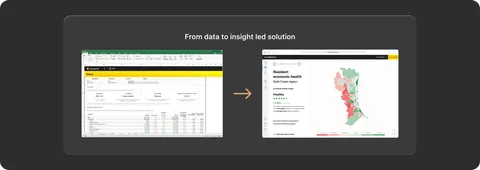
- Demonstrating the business value of simplified, insight-focused solutions
- Applying the CBAIQ Design Excellence Framework to guide our approach
The goal was to complement our analytical strengths with user-centred thinking.
User archetypes transform product thinking
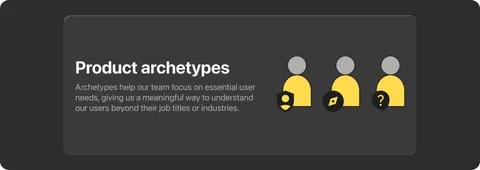
One of the most effective methods I used was introducing user archetypes based on data proficiency. This framework shifted how we viewed our customers and their needs. It included three primary archetypes:
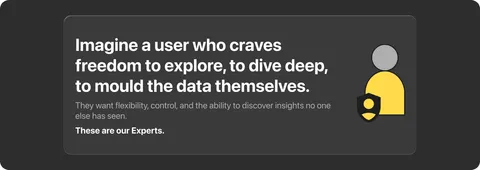
- Experts: Users who prefer raw data to conduct their own analyses
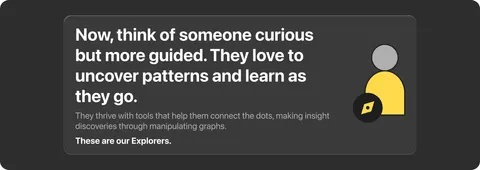
- Explorers: Users who like to manipulate visualisations to discover trends
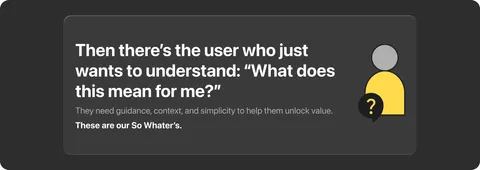
- So Whaters: Users who need clear, actionable insights without complexity
Between them, the three gave the organisation a shared vocabulary for user needs and a way to see how differently customers interact with our products.
The insight that changed everything
The breakthrough was getting the organisation to recognise that even the most technical users eventually need to communicate findings to stakeholders who want clear, actionable insights. I shared this perspective in forums across the organisation. It resonated with leadership, who quickly adopted both the language and concept in their own communications. That made user-centred design relevant to everyone: all data analysis ultimately has to deliver an insight someone can act on.

Breaking the expert feedback loop
I identified a self-reinforcing cycle that limited our perspective:
- Products were optimised for technically proficient users
- Only those users engaged with our solutions
- We received feedback exclusively from this group
- Less technically proficient users were increasingly alienated
Presenting this analysis led leadership to recognise the business opportunity in designing more accessible solutions. It positioned human-centred design as a strategic business imperative rather than a nice-to-have.
From resistance to enthusiasm for user research
At first, there was hesitation about user research. The attitude reflected our identity as experts: we shouldn't need to ask customers what they wanted; we should already know. To address this, I attended customer calls and help sessions to observe firsthand where friction occurred. Those sessions gave me stories to bring back to the team, making user challenges concrete rather than theoretical. As the archetypes framework gained traction, resistance to research began to dissolve. The team became more comfortable with asking questions, showing early iterations, and prototyping with user feedback. Research was increasingly seen as a precision tool rather than an admission of uncertainty.
Workshop-driven collaboration builds momentum
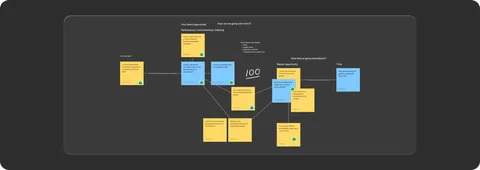
Workshops brought stakeholders together around user needs. I ran them regularly throughout projects, aligning teams on user journeys and pain points. During one project, I facilitated sessions where stakeholders participated in mapping customer journeys and identifying pain points. That created shared ownership of the user experience, with participants becoming invested in addressing the challenges they helped identify. The sessions broke down silos between technical, business, and customer-facing teams, so everyone could see how their role contributed to the user experience.
Evidence of cultural transformation
- Leadership consistently used the archetype language in product strategy discussions
- Other business units began using the framework in their own work
- Team members started initiating their own user research
- Products were increasingly evaluated based on insight accessibility
- Simplified solutions emerged that reduced both development costs and support needs
The approach evolved from design-driven to design-supported, with teams across the organisation adopting user-centred principles.
Impact on product development
The shift changed how products were conceived and delivered:
- Simplified solutions: Products became less complex and more focused on delivering clear insights.
- Reduced delivery costs: More straightforward products required less development effort and support.
- Faster delivery cycles: With clearer priorities based on user needs, teams could build and ship more efficiently.
- Evidence-based decisions: User feedback shaped product decisions, often challenging internal assumptions.
Key learnings for cultural transformation
These principles continue to guide our approach to design leadership:
- Give people language they didn't have: Frameworks and shared vocabulary make invisible concepts discussible and actionable.
- Show rather than tell: Bringing stakeholders into direct contact with user challenges is more powerful than theoretical arguments.
- Position design as business strategy: Connecting human-centred approaches to business outcomes secures leadership buy-in and sustains change.
- Embrace small wins: Cultural change happens gradually through consistent reinforcement and visible successes.
- Hand over the lead: The change is real when team members start human-centred practices themselves.
The transformation to a user-centred culture has fundamentally changed how the organisation approaches product development and customer engagement. What began as a design initiative has become an organisational advantage, enabling us to deliver more value to more customers with greater efficiency.